The Role of Pre-Compiled Headers
Pre-compiled headers allow faster compilation of large projects where multiple source files use the same set of headers. These headers are pre-compiled (once) into an intermediate code, which is used in the compilation of multiple source files. This saves the compiler the need to pre-process all the headers over and over, reducing build time. For example, consider source1.cpp through source25.cpp all use headers header1.h through header7.h. Pre-compiling all 7 headers into one PCH file once allows all 25 compilations to use the pre-compiled header, which is faster in most cases. You can identify a pre-compiled header creation by the /YC option in the CL command.The Issue with Pre-compiled Headers
Consider the above example, and let’s assume that source13.cpp only needs header1.h (it doesn’t need header2.h through header7.h). This means that any change in header1.h should cause a re-compilation of source13.cpp. However, if you use the pre-compiled header when compiling source13.cpp, then any change in header2.h causes a re-compilation of the pre-compiled header, which also cause a re-compilation of source13.cpp. This can happen for incremental builds, and for Build Cache. Inappropriate structure of pre-compiled headers may cause unnecessary re-compilations (i.e. cache misses). For example, if you place all the project headers in one giant pre-compiled header, then a change to any header (something that happens frequently) will cause a re-compilation of the entire project. It is best not to mix in one pre-compiled header both frequently changing headers and those that rarely change.Identifying Improperly Structured Pre-compiled Headers
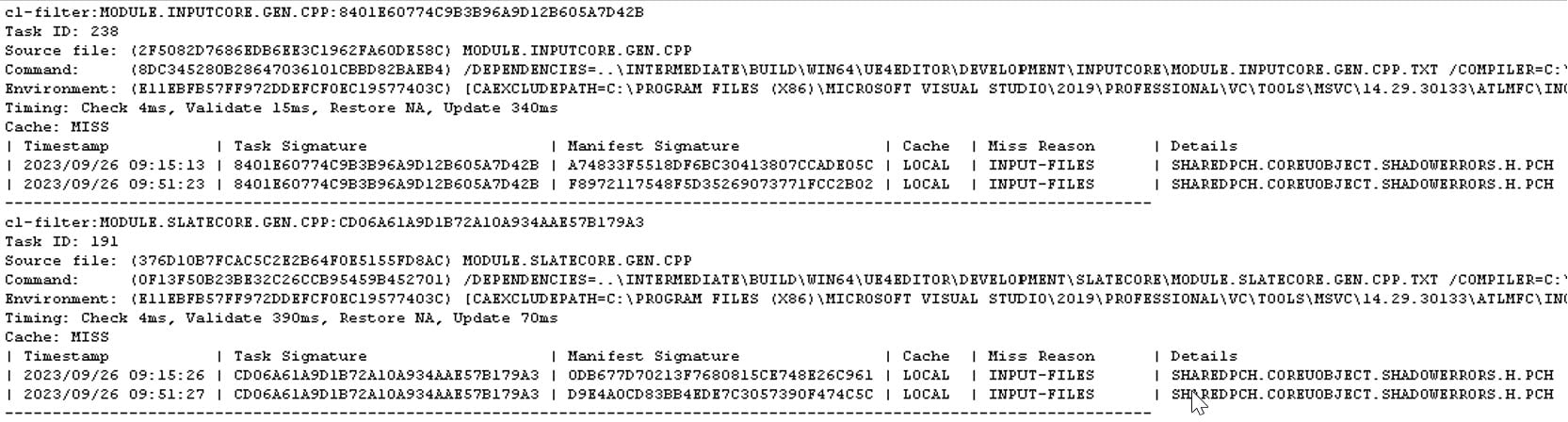
If the builds show low hit rate continuously, enable the detailed build output (see Examining Cache Efficiency Further). If many cache misses show a pre-compiled header (PCH file) as the reason for the miss, then it’s possible that this pre-compiled header contains frequently changing headers and is included by most of the source files.